Designing a network security architecture for multiple offices
Designing a network security architecture for multiple offices
As part of my Networking and Security Practice module, I completed a comprehensive coursework project that required me to design a secure network architecture for a cybersecurity consulting company with multiple branch offices. This project demonstrated my ability to think like a security analyst, design enterprise-grade solutions, and consider both technical and business requirements - understanding systems from the hardware up and designing security controls that protect infrastructure while enabling business operations.
The Challenge
A cybersecurity consulting company based in London needed to connect its branch offices in Scotland, Ireland, Wales, and York. The requirements were clear but challenging:
- Design a network plan connecting all offices
- Create an overall network description discussing architecture and functionality
- Identify hardware and topology requirements
- Design the network using Cisco Packet Tracer with appropriate configuration
- Discuss network protocols used on modern networks
- Analyse the impact of network security knowledge on the design
- Discuss hardware security and its implications
- Identify three challenges to the proposed design and mitigation strategies
This wasn't just a theoretical exercise - it required making realistic assumptions about users, computers, peripherals, Wi-Fi, and hardware requirements, then designing a solution that would work in the real world.
Design Assumptions
Before diving into the technical design, I established three key assumptions that would guide the entire architecture:
1. Scalability
The network infrastructure would be designed to facilitate easy scaling to accommodate an increase in the workforce without significant overhauls. This meant choosing technologies and topologies that could grow with the business.
2. Internet Stability
A robust and reliable Internet connection would be essential for each office, ensuring uninterrupted business operations. This assumption recognised that the entire design depended on stable connectivity.
3. Secure Communication
Given the nature of the company's work - handling sensitive data including confidential documents, databases, and passwords - a secure communication network was vital. The design must comply with GDPR regulations to maintain data privacy and security.
These assumptions ensured the solution would be practical, secure, and scalable - exactly what a real-world customer would need.
Network Solution Architecture
Overall Description
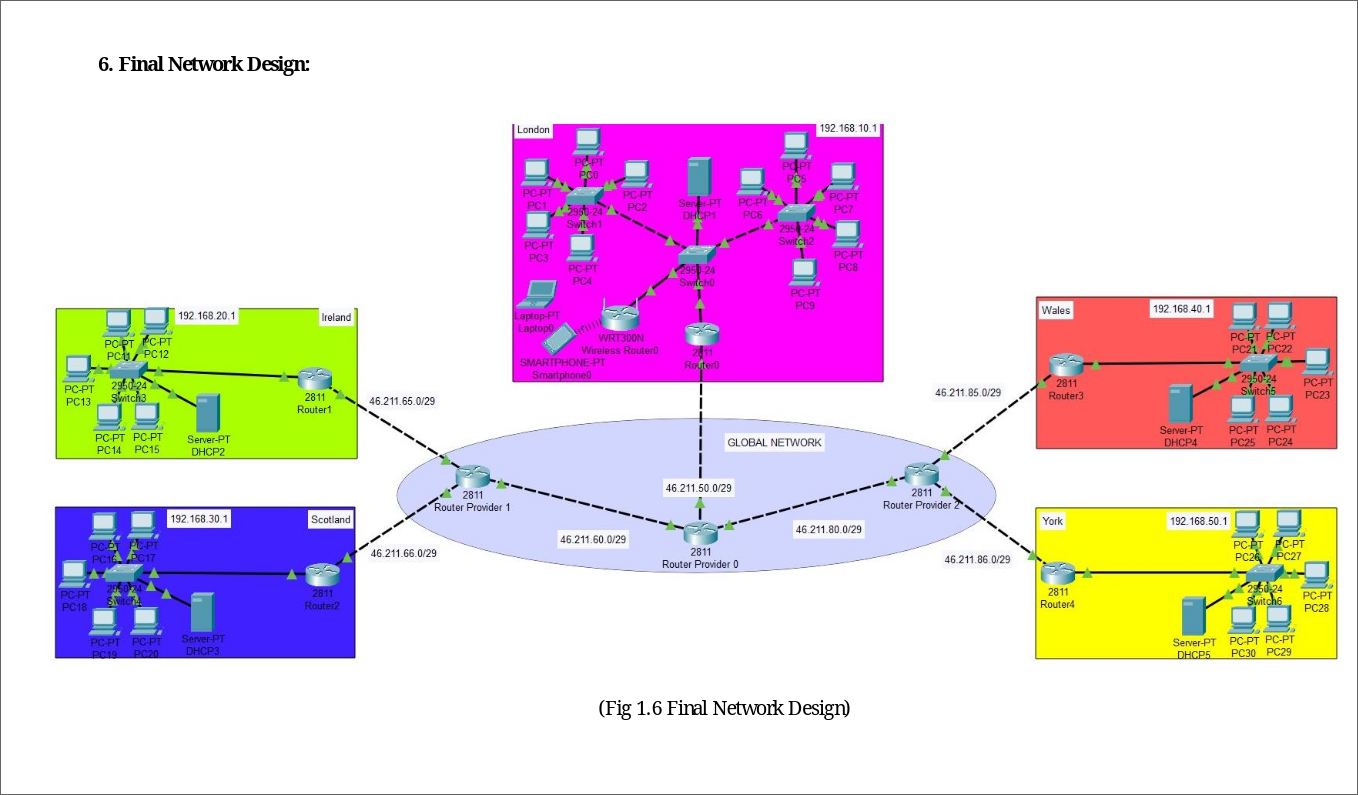
The network architecture I designed creates a secure, interconnected environment where the London headquarters acts as the central hub, with branch offices in Scotland, Ireland, Wales, and York connecting via secure VPN tunnels. This design extends the London office's secure environment to all branches, allowing seamless communication whilst maintaining security.
The architecture follows a star topology with the London office at the centre, providing a reliable and manageable network structure. Each branch office operates as an independent network segment whilst being securely connected to the main office through encrypted VPN tunnels.
Network Solution Components
1. Dynamic Host Configuration Protocol (DHCP)
I implemented DHCP servers with dynamic scope configuration to cater to an expanding number of devices. This allows for automatic IP address assignment, reducing administrative overhead and ensuring efficient network resource management. Each branch office has its own DHCP server to manage local IP address allocation, whilst the main office coordinates overall network addressing.
Benefits:
- Automatic IP address management
- Reduced administrative burden
- Easy device onboarding
- Centralised network configuration
2. Network Address Translation (NAT)
I deployed NAT on all routers across the branches and the main office. This enables private IP addresses within the local network (Class C) to access the Internet through a public-facing IP address (Class A), ensuring all subnets have Internet access whilst keeping the internal network secure.
Security Benefits:
- Hides internal network structure from external threats
- Conserves public IP addresses
- Provides an additional layer of network security
- Enables controlled Internet access
3. Virtual Private Network (VPN)
I established VPN tunnels from each branch office to the main office. This creates a secure communication channel for sensitive information to traverse the Internet safely, effectively extending the London head office's secure environment to the branches.
Implementation:
- Site-to-site VPN tunnels between each branch and headquarters
- Encrypted communication channels
- Secure data transmission over public Internet
- Seamless connectivity for remote offices
The VPN implementation ensures that sensitive data - confidential documents, databases, and passwords - can be transmitted securely between offices whilst complying with GDPR requirements for data protection.
Topology Selection and Rationale
Star Topology
I selected a star topology for the network architecture, with the London headquarters acting as the central hub and branch offices connecting directly to it. This topology was chosen for several key reasons:
1. Reliability and Simplicity
A star topology provides proven reliability. If one connection fails, it does not affect others. This topology also simplifies troubleshooting because each device is independently connected to the hub (router or switch), making it easier to isolate faults. For a cybersecurity consulting company, network reliability is critical - downtime directly impacts business operations.
2. Scalability
The star topology facilitates easy additions, removals, and modifications to the network without disrupting overall connectivity. As the company grows and adds new branch offices or expands existing ones, the network can accommodate these changes with minimal disruption. This aligns with the scalability assumption and ensures the network can grow with the business.
3. Performance
In a star network, each device has a dedicated connection to the hub, so it does not have to compete for bandwidth as in a bus topology. This ensures consistent performance for each branch office, which is essential for a consulting company that relies on real-time communication and data access.
4. Security
The centralised nature of the star topology allows for better implementation of security policies and monitoring, as all traffic passes through the central hub. This makes it easier to implement firewall rules, intrusion detection, and security monitoring at the London headquarters, providing comprehensive security oversight for the entire network.
Hardware and Topology Requirements
Core Hardware Components
London Headquarters:
- Enterprise-grade router with VPN capabilities
- Layer 3 switches for network segmentation
- Firewall for security enforcement
- DHCP server
- Centralised network management system
Branch Offices (Scotland, Ireland, Wales, York):
- Branch routers with VPN client capabilities
- Layer 2/3 switches for local network management
- Local DHCP servers
- Wi-Fi access points for wireless connectivity
- Network security appliances
Network Segmentation
Each office operates as an independent network segment with its own subnet, connected to the main office through VPN tunnels. This segmentation provides:
- Isolation: Network issues in one branch don't affect others
- Security: Compromised branch doesn't automatically compromise the entire network
- Performance: Local traffic stays local, reducing bandwidth usage on VPN links
- Management: Easier to implement branch-specific policies and configurations
Network Protocols
The design utilises several key network protocols essential for modern networks:
Internet Protocol (IP)
The fundamental protocol for network communication, providing addressing and routing capabilities across the entire network infrastructure.
Transmission Control Protocol (TCP)
Ensures reliable, ordered delivery of data between applications. Critical for secure data transmission and VPN connections.
User Datagram Protocol (UDP)
Used for applications requiring low latency, such as real-time communication and network management protocols.
Internet Protocol Security (IPsec)
Essential for VPN implementation, providing authentication and encryption for secure communication between branch offices and headquarters.
Dynamic Host Configuration Protocol (DHCP)
Automates IP address assignment and network configuration, reducing administrative overhead and ensuring consistent network settings.
Network Address Translation (NAT)
Enables private networks to access the Internet securely whilst conserving public IP addresses and hiding internal network structure.
Border Gateway Protocol (BGP) / Open Shortest Path First (OSPF)
Routing protocols that ensure efficient data transmission across the network, though for this design, static routing with VPN tunnels provides sufficient control.
Impact of Network Security Knowledge
Having adequate network security knowledge was crucial throughout the design process. This knowledge influenced every decision:
Security-First Design
Understanding network security meant designing with security in mind from the start, rather than adding it as an afterthought. This resulted in a more robust and secure architecture.
Threat Awareness
Knowledge of common network threats - man-in-the-middle attacks, data interception, unauthorised access - directly influenced the decision to implement VPN tunnels and network segmentation.
Compliance Considerations
Understanding GDPR requirements and data protection regulations ensured the design included appropriate security measures for handling sensitive data.
Defence in Depth
Security knowledge enabled implementation of multiple security layers: VPN encryption, NAT, network segmentation, and firewall rules, creating a comprehensive security posture.
Risk Assessment
The ability to assess security risks allowed identification of potential vulnerabilities and implementation of appropriate mitigations before they became problems.
Hardware Security and Implications
Hardware security is a critical consideration in network design, with several important implications:
Physical Security
Network hardware must be physically secured to prevent unauthorised access. Routers, switches, and servers should be located in secure, access-controlled areas. Compromised hardware can provide attackers with direct network access.
Firmware and Software Updates
Regular updates to router firmware and network device software are essential to patch security vulnerabilities. Outdated firmware can expose the network to known exploits.
Default Configurations
Many network devices ship with default passwords and insecure configurations. Changing default settings, implementing strong passwords, and disabling unnecessary services are fundamental security practices.
Hardware-Based Security Features
Modern network hardware includes built-in security features such as hardware-accelerated encryption for VPNs, dedicated security processors, and secure boot capabilities. Utilising these features enhances overall network security.
Supply Chain Security
Ensuring network hardware comes from trusted suppliers and hasn't been tampered with is important for maintaining network integrity. Compromised hardware can introduce backdoors or vulnerabilities.
Redundancy and Resilience
Hardware failures can disrupt network operations. Implementing redundant hardware and failover capabilities ensures network availability even when individual components fail.
Challenges and Mitigation Strategies
Three key challenges could impact the proposed network design:
Challenge 1: VPN Tunnel Reliability and Performance
The Challenge: VPN tunnels over the Internet can experience latency, packet loss, and connection instability, especially when connecting offices across different countries (Scotland, Ireland, Wales, York to London). This could impact real-time applications and user experience.
Mitigation Strategies:
- Multiple Internet Service Providers (ISPs): Implement redundant Internet connections at each office to provide failover capabilities
- Quality of Service (QoS): Configure QoS policies to prioritise critical traffic (VPN tunnels, voice, video) over less critical traffic
- VPN Monitoring: Implement continuous monitoring of VPN tunnel health with automatic failover to backup connections
- Bandwidth Management: Ensure adequate bandwidth allocation for VPN tunnels based on expected traffic loads
- Connection Optimisation: Use VPN protocols and configurations optimised for performance, such as IPsec with hardware acceleration
Challenge 2: Network Scalability and Future Growth
The Challenge: As the company grows, the network must accommodate additional users, devices, and potentially new branch offices without requiring complete redesign or significant downtime.
Mitigation Strategies:
- Modular Design: Design the network in modular components that can be easily expanded or modified
- IP Address Planning: Implement a scalable IP addressing scheme with room for growth (e.g., using Variable Length Subnet Masking)
- Centralised Management: Use network management systems that can easily accommodate new devices and branches
- Standardised Configurations: Create standardised configuration templates for new branch offices to ensure consistency and simplify deployment
- Capacity Planning: Regularly assess network utilisation and plan for capacity increases before bottlenecks occur
- Cloud Integration: Consider hybrid cloud solutions that can scale more easily than on-premises infrastructure alone
Challenge 3: Security Threats and Compliance
The Challenge: Cybersecurity consulting companies are high-value targets for attackers. The network must protect against sophisticated threats whilst maintaining compliance with GDPR and other regulations. A security breach could have severe consequences for both the company and its clients.
Mitigation Strategies:
- Defence in Depth: Implement multiple layers of security (firewalls, intrusion detection, VPN encryption, network segmentation) so that a failure in one layer doesn't compromise the entire network
- Regular Security Audits: Conduct periodic security assessments to identify and remediate vulnerabilities
- Security Monitoring: Implement comprehensive logging and monitoring to detect suspicious activity and potential breaches
- Employee Training: Ensure all staff understand security policies and best practices, as human error is often the weakest link
- Incident Response Plan: Develop and regularly test incident response procedures to minimise damage if a security breach occurs
- Compliance Framework: Implement security controls aligned with GDPR requirements, including data encryption, access controls, and audit logging
- Zero Trust Architecture: Consider implementing zero trust principles where possible, verifying every connection and transaction regardless of location
Implementation in Cisco Packet Tracer
The network design was fully implemented in Cisco Packet Tracer, allowing me to:
- Visualise the Architecture: Create a clear visual representation of the network topology
- Test Configurations: Verify that VPN tunnels, routing, and network services function correctly
- Validate Design Decisions: Ensure the star topology and network segmentation work as intended
- Demonstrate Functionality: Show how data flows between branch offices and headquarters
The Packet Tracer implementation included:
- Routers configured with VPN capabilities at each location
- Switches for local network connectivity
- End devices (computers, servers) representing users and services
- Proper IP addressing and subnetting
- VPN tunnel configurations
- DHCP server configurations
- NAT implementations
This hands-on implementation validated the theoretical design and demonstrated practical network configuration skills.
Key Learnings and Relevance to Cybersecurity Analysis
This project directly demonstrates skills essential for cybersecurity analysts:
Security Architecture and Risk Assessment
Designing a complete network architecture that balances security, performance, scalability, and cost requires the same analytical thinking that cybersecurity analysts use when assessing security risks and designing monitoring strategies. Understanding business requirements, making appropriate assumptions, and designing comprehensive security solutions are core cybersecurity analyst skills.
Technical Depth
The project required deep understanding of network security principles: VPN technologies, network segmentation, NAT, firewall concepts, and security best practices. Cybersecurity analysts need this technical depth when analyzing security incidents, developing monitoring tools, and explaining security tradeoffs to stakeholders.
Threat Modeling and Security Design
The project involved identifying potential security threats (unauthorized access, data interception, network attacks) and designing mitigations. This threat modeling approach is exactly what cybersecurity analysts do when evaluating systems and developing security controls.
Stakeholder-Focused Approach
The project required considering business requirements (scalability, reliability, compliance) alongside technical requirements. Cybersecurity analysts must always balance security solutions with business needs, communicating tradeoffs clearly to stakeholders.
Presentation and Communication
Creating clear documentation, explaining design decisions, and presenting the solution effectively are essential cybersecurity analyst skills. This project required articulating complex technical concepts in a way that demonstrates understanding and rationale - exactly what's needed when explaining security decisions and incident findings to technical and non-technical stakeholders.
Problem-Solving and Methodical Investigation
Identifying challenges and developing mitigation strategies required analytical thinking and problem-solving skills. Cybersecurity analysts regularly face complex security incidents and must perform methodical investigations to identify root causes and develop effective remediation strategies.
Conclusion
This network security architecture design project was a comprehensive exercise in thinking like a network security professional. It required understanding not just the technical aspects of networking, but also security principles, business requirements, and real-world challenges.
The design successfully addresses the requirements: connecting multiple branch offices securely, implementing appropriate network protocols, considering security implications, and identifying potential challenges with mitigation strategies. The star topology with VPN tunnels provides a reliable, scalable, and secure solution that meets the needs of a cybersecurity consulting company handling sensitive data.
More importantly, this project demonstrated my ability to design enterprise-grade security solutions, understand systems from the hardware up, and think through real-world security challenges - exactly the skills that make an effective cybersecurity analyst. The ability to analyze security architectures, explain security tradeoffs clearly, and develop practical solutions to protect infrastructure is what cybersecurity analysts do every day when working with stakeholders.
This coursework wasn't just an academic exercise; it was practical experience in security architecture design, threat modeling, and risk assessment that directly translates to the work of protecting infrastructure, developing monitoring tools, and handling incident response.